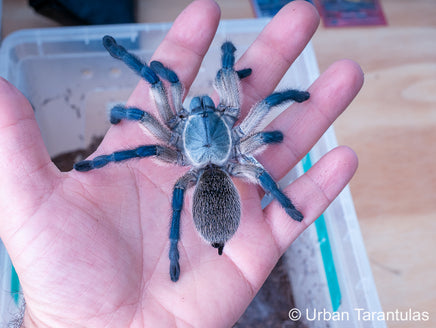
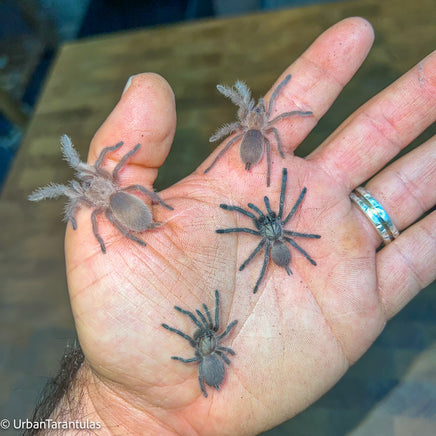
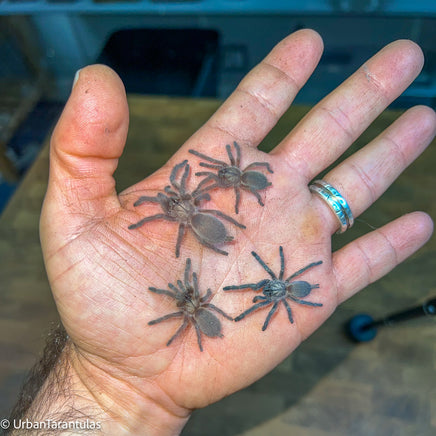
Monocentropus balfouri — Socotra Island Blue Baboon 🕷️
Known as the “Social Butterfly” of the tarantula world, Monocentropus balfouri is one of the very few species that thrives communally. Hailing from the remote Socotra Island off Yemen, this blue-beige beauty blends stunning appearance with remarkable behavior — often sharing meals and living peacefully in groups. A truly mesmerizing Old World species that redefines how we think of tarantulas.
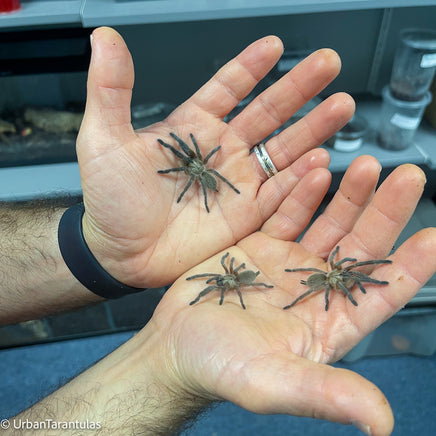
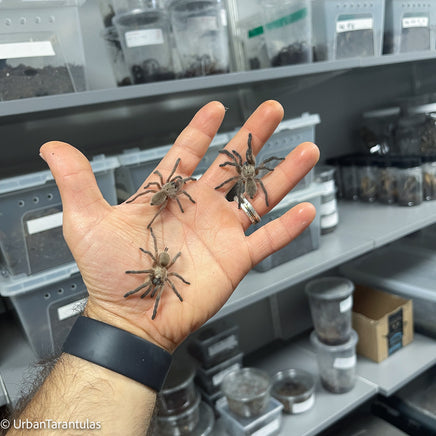
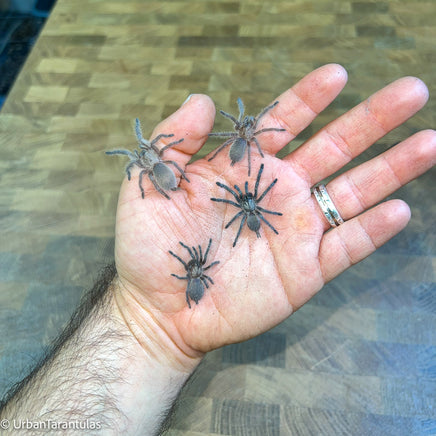
**I’ve specialized in M. balfouri for over 14 years and I’m currently the largest breeder of this species in the United States. I've also kept the largest known communal—646 individuals—which you can see on my social media. When you buy from me, you’re getting healthy specimens already used to living together (never tiny fragile slings), and sizes may vary depending on availability. Whether you’re looking for a solitary spider, a small or large communal, or even a paired/gravid female, I usually have them. Stock can occasionally run low, but the quantities and sizes listed on the website are generally accurate to what’s available at that moment.
M. balfouri can breed in a communal setting, but the egg sacs almost always get damaged or run over by other individuals. I’ve never had a successful sac while the female stayed inside the communal. If you want a real chance at a sac, keep the paired or gravid female by herself until she drops and guards it.
For communal setups, the best start is six or more, but starting with two is fine as long as they’re kept very close together. Less space is better—they naturally huddle for warmth. They thrive when warm; if you want them visible and active, keep temperatures in the upper-70s to low-80s °F. Even though they’re a dry species, lightly misting the enclosure a few times a month helps with hydration and simulates occasional rain. Substrate shouldn’t be soaking wet, but also not bone-dry all the time. A simple layout works perfectly: substrate on the bottom with a flat piece of cork on top—they usually gather underneath as a group.
Disclaimer: If you purchase a gravid/paired/pregnant balfouri female, that does NOT guarantee you will get an eggsac. No reputable dealer/seller will ever sell an animal and promise or guarantee that the animal will lay a sac. All I can guarantee is that she paired. I've had dozens of customers that have gotten egg sacs from paired balfouri's that have been purchased from me. More success stories than failed ones. And if your female does NOT produce and molts out, just reach out to me and i'll give you a really good deal on a mature male or an immature male so you can try to breed again.
| 📣 Special Notices |
Watch the full husbandry and setup video before you buy!
🎥 Visit Urban Tarantulas on YouTube for exclusive videos on care, feeding, and communal setups.
All babies are currently feeding on small crickets. Each one is expertly raised here at Urban Tarantulas under our thriving communal conditions — the largest and most successful in the nation. |
| 🌿 Care Details |
| 🌡️ Temperature |
77–80°F (25–27°C) |
| 💧 Humidity |
Low to moderate; light misting weekly and a dry, arid setup |
| 🏠 Housing ** These are just rough estimates. Keep them tight and in close quarters. |
| Babies |
- 1-5 babies: 5x5x3 container
- 6-12 babies: 8x8x5 container
- 13-25 babies: 12x12x6 container
|
| Juveniles |
- 1-5 juvie: 6in diamater
- 6-12 juvie: 10in diamater
- 13-25 juvie: 12in diamater
|
| Adults |
- 1-5 adults: 8-10in diamater
- 6-12 adults: 12in to 14in diamater
- 13-25 adults: 16in diamater
|
| 🍽️ General Diet |
| Crickets and roaches (Dubia, Red Runner, Lobster, Madagascar Hissing). Babies eat small crickets or roaches. If prey is too big, pre-kill and remove leftovers promptly. Occasionally, adult females may enjoy a pinky mouse or feeder lizard as a rare treat. |
| 📘 In-depth Facts |
| 🕷️ Latin name |
Monocentropus balfouri |
| 📛 Common name(s) |
Socotra Island Blue Baboon |
| 🌡️ Temperature |
77–80°F |
| 💧 Humidity |
50–60%, lightly misted weekly |
| 📍 Locale |
Socotra Island, off the coast of Yemen |
| 🏷️ Category |
Old World terrestrial; opportunistic burrower; communal species |
| 📏 Size |
Females 6.5–7.0"; males slightly smaller |
| 🪶 Urticating hairs |
None — they do not kick urticating hairs |
| ⏳ Growth rate |
Fast when kept warm (~77°F) |
| 🧭 Life span |
Females up to 15 years; males up to 4 years |
| 🍽️ Feeding |
Active eaters; communal feeding observed |
| 🎯 Recommended levels |
Beginner-friendly despite being Old World — calm, social, and hardy |
| 🎁 Follow Me on Social Media |
🎁 Follow me on social media and receive an additional freebie*
*Email me after you follow to let me know you’re a follower so I can include it.
|
| ⚠️ Safety Disclaimer |
Safety Disclaimer: Experiencing a tarantula bite is an extremely rare occurrence, and it's important to note that there have been NO recorded fatalities due to a tarantula bite. The venom potency varies across species, with Old World tarantulas generally having stronger venom than their New World counterparts. Within the Old World category, the Poecilotheria genus is known for having particularly potent venom.
It's crucial to approach tarantulas with respect and understanding. If you happen to get bitten, which is unlikely, the key is to stay calm. In most cases, the discomfort is superficial and subsides within a few minutes to a few hours. However, bites from species with more potent venom may result in symptoms lasting up to a week. Remember, larger tarantulas tend to have more venom than smaller ones.
Please be aware that I cannot assume responsibility for bites. Tarantula handling should be done at your own risk. In my 13 years of experience with these creatures, I have only been bitten once, by a species with highly potent venom. While the experience was painful, the symptoms had completely disappeared after a week.
Handle tarantulas responsibly, and always prioritize your safety and the well-being of the tarantula. |