| A little help getting started |
|
A free starter container for small slings is available if requested at checkout; it is not included automatically.
Visit Urban Tarantulas on YouTube for care, setup, feeding, and show-and-tell videos to see how we keep and feed our tarantulas.
|
| 🌿 Keep the routine simple |
|
Provide stable room temperatures, good ventilation, a sheltered retreat, and fresh water. Larger Red Knees do well with mostly dry surface substrate and a lightly moistened corner. Small slings need closer attention to drying out.
Avoid direct sunlight, heat lamps, and constantly wet substrate. A comfortable enclosure gives the spider somewhere to retreat and enough digging room to arrange its own space.
|
| 🏠 Housing through each stage |
|
Babies / slings
A ventilated 1–4 oz deli cup can suit small slings. Match the container to the spider, use escape-proof ventilation holes, and provide gently packed substrate for burrowing. Keep a small area or lower layer slightly moist while leaving a drier area available.
Juveniles
Move into a low terrestrial enclosure with a cork-bark hide, digging space, and a small water dish. Increase floor space gradually as the spider grows.
Adults
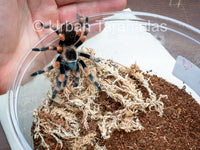
Use a secure enclosure with roughly three leg spans of length and two of width as a practical starting point. Provide generous substrate depth and low clearance above it to reduce fall risk. Include a stable hide and shallow water dish. House individually.
|
| 🍽️ Feeding & molting |
|
Offer appropriately sized captive-bred crickets or roaches, including Dubia, Red Runners, and Lobster roaches. Use tiny feeders for slings; freshly pre-killed prey is an option when available insects are too large to tackle safely.
As a starting point, offer slings food about weekly and larger specimens every 1–2 weeks. Adjust to abdomen condition, prey size, and appetite. Remove uneaten food within 24 hours.
Patience is part of keeping a Red Knee. Food refusal can accompany premolt or a normal fast. Remove live feeders when premolt is suspected, leave molting spiders undisturbed, and resume feeding only after their fangs have hardened.
|
| Your Red Knee at a glance |
| 🕷️ Scientific name |
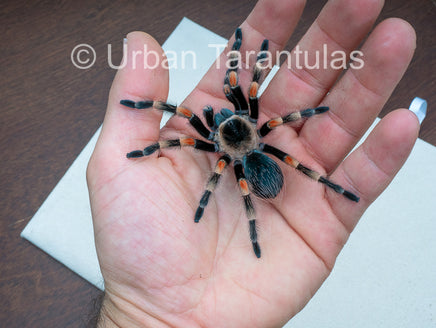
Brachypelma hamorii
Tesmoingt, Cleton & Verdez, 1997 |
| 📛 Common names |
Mexican Red Knee; Mexican Redknee; Mexican Orange Knee. |
| 🌡️ Temperature |
Approximately 70–78°F (21–26°C). Stable room conditions are a practical starting point. |
| 💧 Humidity |
Low to moderate ambient humidity. Prioritize a mostly dry surface, a lightly moistened area, ventilation, and drinking water over a fixed percentage. Keep small slings from drying out completely. |
| 📍 Locale |
Western Mexico, including Colima, Jalisco, and Michoacán; associated with seasonally dry forest and sheltered burrows. |
| 🏷️ Category |
New World terrestrial / burrowing species. Generally light visible webbing, with silk around retreats and molt sites. |
| 📏 Adult size — DLS |
Female: approximately 5–6 inches (13–15 cm).
Male: lankier at maturity; a dependable separate male DLS range is not established in the care references used here.
DLS means diagonal leg span, not body length. A smaller body does not necessarily mean a shorter leg span.
|
| 🪶 Urticating hairs |
Yes—if disturbed, they can flick urticating hairs as a natural defense. Individual responses vary. |
| ⏳ Growth rate |
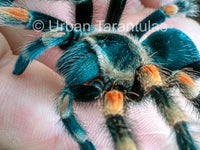
Slow. Small slings gradually develop the bold knee markings and proportions seen in adults. |
| 🧭 Lifespan |
Female: roughly 20–30+ years.
Male: roughly 5–10 years.
Approximate captive estimates of total lifespan. Maturation time and individual longevity vary.
|
| 🎯 Recommended level |
Beginner-friendly with the right setup, and a classic choice for Brachypelma lovers. A great match for keepers who enjoy bold colors, gradual growth, and a simple care routine. |
|
Hamorii or smithi? They are two distinct species, both commonly called Mexican Red Knees. Many older hobby references used B. smithi for animals now identified as B. hamorii. It was a history of mistaken identity—not simply a name change that made B. smithi disappear.
|
| Stay connected |
|
🎁 Follow me on social media and receive an additional freebie*
*Email me after you follow to let me know you’re a follower so I can include it.
|
| Safety disclaimer |
| Tarantulas can bite, and this species has hairs that can irritate skin and eyes. Enjoy observing it and use a catch cup for transfers. Keep your face away during maintenance and protect the spider from falls. Seek medical advice after a bite or significant hair exposure, especially to the eyes. Handling is at your own risk. Always prioritize your safety and the tarantula’s well-being. |